Cloud Infrastructure
Understanding the October 2025 AWS Outage: Impacts, Causes, and Strategies for Resilience
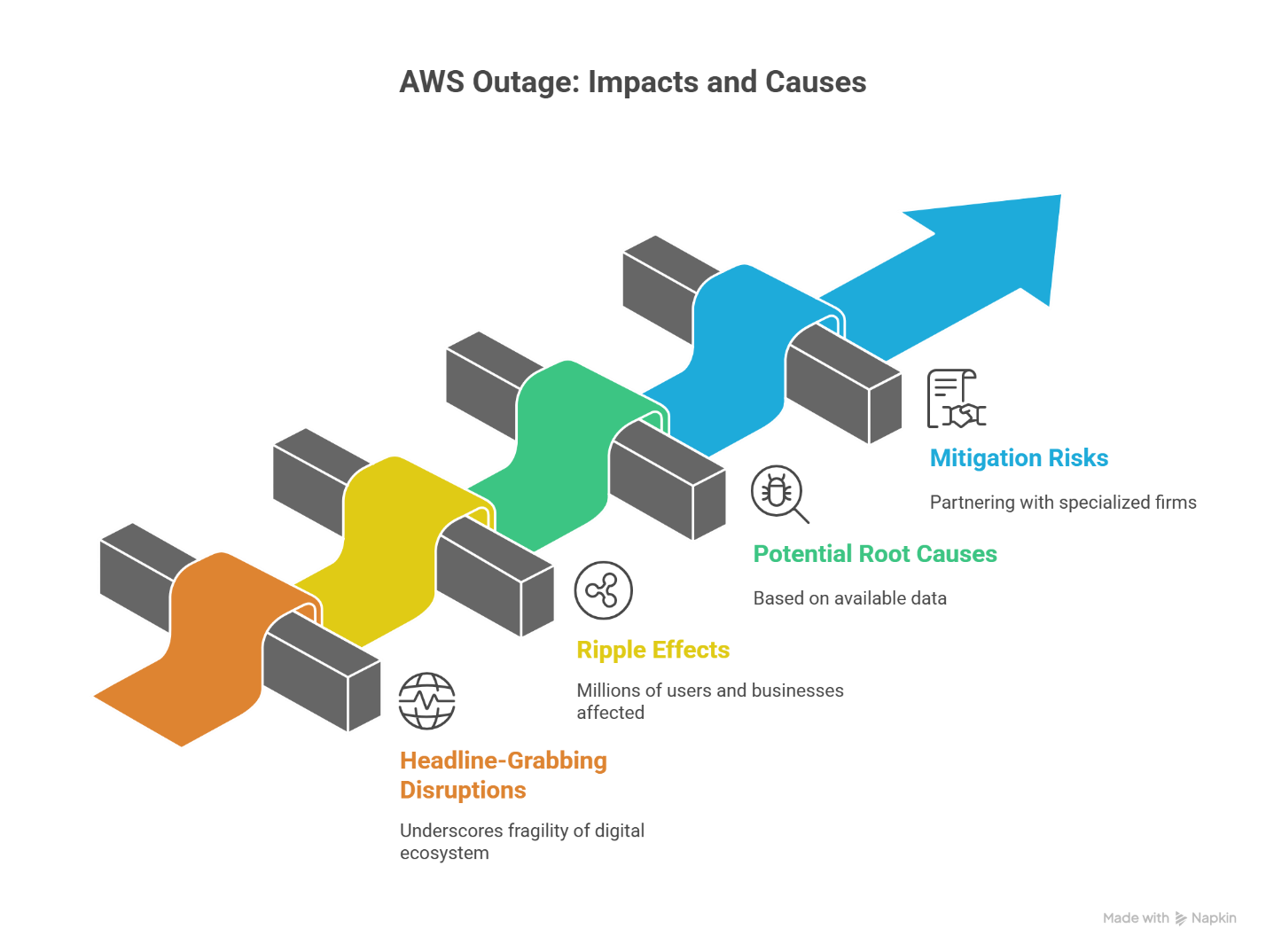
The recent AWS outage on October 20, 2025, sent shockwaves through the cloud computing infrastructure world, leaving millions of users and businesses scrambling as familiar apps and services went dark. Starting with the headline-grabbing disruptions, this event underscored the fragility of our digital ecosystem, even with giants like Amazon at the helm. In this deep dive, we'll break down exactly what transpired, the ripple effects, potential root causes based on available data, and practical insights for cloud users. We'll also explore how partnering with specialized firms can help mitigate these risks, drawing from reliable sources to ensure accuracy.
Timeline of the Disruption: From Onset to Recovery
The outage kicked off late on October 19, 2025, at approximately 11:49 PM PDT, centered in AWS's US-EAST-1 region—a hub for many global services. By early October 20, reports flooded in of widespread issues, with peak complaints around midday. AWS's Health Dashboard logged increased error rates and network connectivity problems, affecting everything from database queries to instance launches.
Recovery efforts progressed in stages. By 2:24 AM PDT on October 20, initial mitigations resolved some DNS-related hiccups, but full restoration didn't occur until 3:01 PM PDT, with all services normalized by 3:53 PM PDT. Post-recovery, AWS noted lingering backlogs in services like Config, Redshift, and Connect, which were cleared within hours. Real-time monitoring from sites like ThousandEyes confirmed the regional focus but global fallout.
Social media, particularly X (formerly Twitter), buzzed with user frustrations—posts about lost Snapchat streaks, delayed educational platforms like Canvas, and even jokes about the timing coinciding with other tech events. This real-time chatter highlighted how quickly such incidents escalate public concern.
What Was Affected: A Broad Spectrum of Disruptions
The outage's scope was staggering, touching 142 AWS services and cascading to third-party apps reliant on them. Core infrastructure like Amazon Elastic Compute Cloud (EC2), DynamoDB, Simple Queue Service (SQS), and Lambda saw impaired functionality, leading to slower responses or outright failures.
Consumer-facing impacts were immediate and visible:
Social and Entertainment Apps: Snapchat users couldn't send snaps or load stories; Fortnitev and Roblox gamers faced login issues; Prime Video streaming halted for some.
Smart Home Devices: Ring doorbells and Alexa-enabled products went offline, raising security concerns for homeowners.
Financial Services: Platforms like Coinbase and Robinhood experienced trading disruptions, potentially affecting market activities.
Business and Education Tools: Canvas by Instructure reported unavailability, impacting students and teachers; Qualtrics surveys and Smartsheet workflows slowed.
Other Sectors: Airlines dealt with booking system glitches, and even mutual aid apps like Venmo saw SMS verification delays.
Globally, the event disrupted websites and services far beyond the U.S., as many rely on US-EAST-1 for endpoints like IAM and global tables. Down Detector logged thousands of reports, peaking before dropping as recovery advanced.
This table illustrates the diversity of impacts, emphasizing AWS's central role in modern digital operations.
Why It Happened: Unpacking the Technical Causes
While AWS has committed to a detailed post-event summary, early analyses point to a chain reaction starting with DNS resolution failures for regional DynamoDB endpoints around 12:26 AM PDT on October 20. This impaired an EC2 subsystem for instance launches, which depend on DynamoDB. Compounding this, network load balancer (NLB) health checks failed due to an internal monitoring subsystem glitch within EC2's network.
Experts like those from ThousandEyes and CBT Nuggets suggest such outages often arise from overlooked dependencies or scaling pressures in high-traffic regions like US-EAST-1. Al Jazeera's coverage noted that while AWS bore primary responsibility, client-side configurations (e.g., single-region reliance) amplified effects for some users. This isn't AWS's first rodeo—similar events in past years have involved power failures or software bugs, but this one appears more network-centric.
Counterarguments from tech communities on X highlight that over-reliance on one provider invites these risks, with some users joking about "ragequits" from AWS dependencies. Overall, the evidence leans toward an internal technical fault rather than external factors like cyberattacks, though investigations continue.
Key Things to Know: Lessons and Best Practices
This outage scared cloud users by revealing vulnerabilities in even the most robust systems. Here are essential insights:
Single-Region Risks: US-EAST-1's popularity makes it a single point of failure; AWS recommends multi-AZ (Availability Zone) and multi-region architectures.
Dependency Mapping: Understand how services like Lambda or SQS interconnect—throttling during recovery showed how one failure cascades.
Recovery Strategies: Retry failed requests, flush DNS caches, and use auto-scaling groups across zones to bounce back faster.
Broader Implications: It affected global economies, from stock trading to education, prompting discussions on cloud monopoly and diversification.
Historical Context: AWS outages aren't rare—past incidents in 2021 and 2023 involved similar regional issues, but response times have improved.
For businesses, these events highlight the value of expert management. Candidly, if you're not a cloud wizard, leaning on a Managed Service Provider (MSP) like Tylextech makes sense. As an MSP, MSSP (Managed Security Service Provider), and MSIT firm, Tylextech specializes in overseeing IT infrastructures, including cloud security and hybrid setups. They can assess your AWS dependencies, implement failover to alternatives like Azure or Google Cloud, and provide 24/7 monitoring to prevent outage-induced chaos. It's not about ditching AWS—it's about building smarter resilience. Users on X echoed this, with firms like KOHO and Northwestern IT sharing how they navigated the storm through diversified providers.
In summary, while the October 2025 AWS outage was a wake-up call, it also showcases the industry's quick recovery capabilities. By learning from it and partnering with pros like Tylextech, cloud users can turn fear into fortified strategies.